
Key Takeaways
- We usually recommend a cheap 7 seater car rental over two cars when most or all passengers are travelling to the same places at roughly the same times.
- One larger vehicle can mean one rental fee, one driver, one parking space, and fewer road-related expenses to account for.
- For a family car rental, passenger numbers alone are not enough. Luggage, child seats, and how much usable boot space remains with all seats occupied matter too.
- Two cars may still make more sense when passengers have different schedules, destinations, or transport needs.
- If you only need additional seating temporarily, renting a 7-seater can give you the extra capacity without committing to a larger vehicle long term.
- Our flexible car rental in Singapore options allow you to select a vehicle around the period and capacity you actually require.
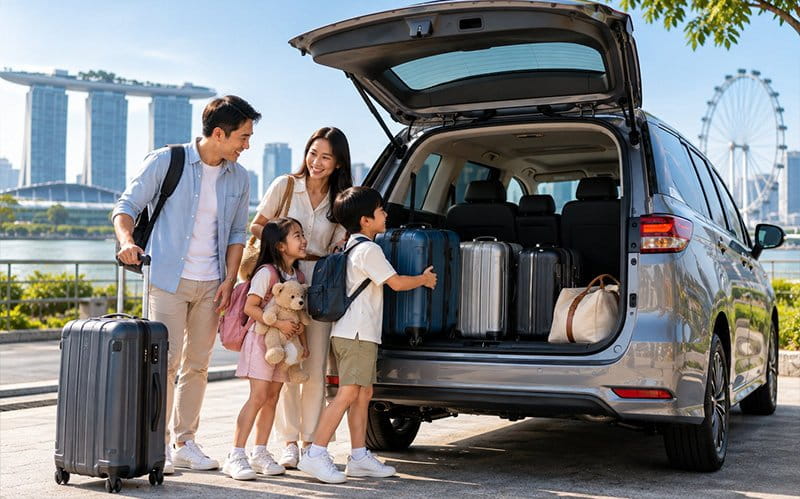
When customers ask us whether they should rent a 7-seater or simply use two smaller cars, our answer is usually straightforward: if the group is travelling together for most of the rental period, we would look at the 7-seater first.
That does not mean the largest vehicle is automatically the best option. In our experience, the decision becomes clearer when you compare the whole journey rather than just the advertised rental price.
Two cars mean two vehicles to fuel, two drivers to coordinate, and potentially two parking spaces and two sets of road charges. A cheap 7 seater car rental can therefore make considerably more sense when the extra seats will actually be used.
When Everyone Is Following the Same Itinerary
This is the first thing we look at.
If six or seven people are leaving from roughly the same place, visiting the same destinations, and returning together, splitting the group across two cars usually adds complexity without giving you much extra flexibility.
We commonly see this with:
- extended families travelling together;
- relatives visiting Singapore;
- wedding or event groups;
- weekend family outings; and
- groups attending the same functions throughout the day.
With one car, there is only one route to plan and one vehicle to park. Nobody needs to message the other driver to ask where they are or wait at the destination for the second car to arrive.
For these situations, we generally find a cheap 7 seater car rental to be the more practical starting point.
When Two Cars Would Duplicate Driving Costs
We also recommend comparing more than the daily rental rates.
Using two cars can mean paying twice for costs that arise on the same journey. Both vehicles consume fuel. Both require parking. Depending on the route and time, both may also pass through chargeable ERP gantries.
Motorists incur ERP charges when their vehicles pass through operational ERP gantries, with rates depending on factors such as the vehicle type and time of entry.
That does not mean one 7-seater will always be cheaper. Fuel consumption, rental rates, routes, and parking arrangements differ. However, if two vehicles will follow almost exactly the same journey every day, we think those duplicated costs should form part of the comparison.
For stays lasting several weeks, it can also be useful to compare a monthly car rental in Singapore rather than looking only at short daily rates.
When You Need More Space for Airport Runs
Airport transfers are one of the clearest examples of when we recommend a 7-seater, but there is an important caveat.
Seven seats do not necessarily mean space for seven passengers and seven large suitcases.
Whenever customers are arranging a family car rental for an airport journey, we ask them to consider both passenger and luggage capacity. With every seat occupied, some 7-seaters have relatively limited cargo room.
A group of five with several suitcases may therefore benefit more from a spacious MPV than a group of seven travelling with large luggage.
This is why we prefer looking beyond a basic MPV comparison in Singapore based on seat numbers. The practical question is how many people and how much cargo the vehicle needs to carry at the same time.
When You Only Occasionally Need Seven Seats
Another situation where we favour renting is when the need for a larger vehicle is temporary.
Perhaps your normal car works perfectly well for a household of four, but relatives are visiting for a month. You might need extra seats during the school holidays or while grandparents are staying. You may simply have several family occasions coming up close together.
We would not view those occasional needs as a reason to change your everyday vehicle automatically.
A cheap 7 seater car rental gives you access to a higher-passenger-capacity vehicle for the period when you actually need it. Afterwards, you return it rather than continuing to bear the cost and compromises of driving a larger car throughout the year.
For customers comparing longer arrangements, we also recommend looking at car leasing rates in Singapore and considering the rental duration alongside the headline rate.
When One Driver Is More Practical Than Two
Two cars require two available drivers.
That can become inconvenient when some members of the group do not drive, are visiting from overseas, or simply prefer not to navigate unfamiliar roads.
It can also matter after dinners, celebrations, or long days out. Even when there are technically two licensed drivers in the group, that does not necessarily mean both want to drive everywhere.
If one confident driver can comfortably transport the entire group, one vehicle can simplify the arrangement considerably.
When We Would Still Recommend Two Cars
There are situations where we would advise customers not to choose a 7-seater purely to save money.
Two cars may be better when:
- passengers regularly travel to different destinations;
- one group needs to leave much earlier or later than the other;
- seven passengers also need substantial luggage space;
- you need two vehicles available independently during the rental period; or
- several passengers would be uncomfortable in the third row for longer journeys.
This is why the cheapest advertised option should not determine the decision by itself.
A good-value cheap 7 seater car rental should give you suitable space and flexibility for the way you will actually travel. If passengers constantly need to compromise on luggage room, comfort, or schedules, saving on one vehicle may not represent better value overall.
How We Help You Decide at Ecube
At Ecube, we recommend starting with three questions: How many people are travelling? How much luggage or equipment are they carrying? Will they usually travel together?
If six people are following one itinerary, one 7-seater will often be our recommendation. If the same six people need independent transport throughout the day, two cars may serve them better.
We can also help you compare vehicle size, rental duration, and pricing rather than choosing solely from a headline daily rate.
If you are deciding between one 7-seater and two smaller cars, contact us. Tell us how many people are travelling, how long you need the vehicle, and how you expect to use it, and we can help you work out which arrangement makes more practical sense.
Frequently Asked Questions
How many people can comfortably fit in a 7-seater rental?
Most 7-seaters accommodate up to seven people, but third-row comfort varies. Taller adults may prefer shorter journeys there, while children usually fit more comfortably.
Can a 7-seater fit luggage with all seats occupied?
Boot space may be limited when all seven seats are in use. For airport trips, we recommend checking luggage capacity alongside passenger numbers before choosing a vehicle.
Is a cheap 7 seater car rental suitable for families with young children?
Yes, but child seats can reduce usable passenger space. Check the seating layout beforehand, especially if you need more than one child restraint.
Is a 7-seater better for a weekend or longer rental?
Both can work. Weekend rentals suit short trips and events, while longer rentals may offer better value when you need extra seating for several weeks.
What should I compare between different 7-seater rentals?
Compare passenger comfort, boot space, fuel use, rental terms, insurance, mileage limits, and support. The cheapest rate is not always the best overall value.
 eCube Auto